

Been a while again since I managed to finish a book, but I finally did! This was on my to-read list pretty much since it was published in 2015 and I managed to loan it when visiting Finland a few weeks back. The name could translate as: “Leading by fear sucks”, though “perseestä” literally means from the ass, but I guess it’s not really used that way in English… Anyway, a strong and slightly controversial title for an important topic.
Although I studied business, I’m not super familiar with the field of leadership literature and would love to study more of it in the future. And of course, leadership isn’t just for the business people. Everyone needs skills in at least leading themselves and when it comes to leading teams and organisations, skills in communication, empathy and motivation become even more important. And leading by fear has negative consequences.

The book itself was surprisingly unstructured, consisting mainly of quotations, or stories, from people working in different organisations. Parts of the book had lines where the reader could write his / her own thoughts, which is kind of nice if one wants to develop their leadership skills. However, personally I found it a bit strange reading so many quotations, some of which weren’t exactly demonstrating leading by fear and were a bit off topic. From time to time it felt more like reading the vauva.fi forum. I also spotted quite a few misspellings and a few sentences I couldn’t even understand because of bad writing, not just in the quotations, but from the authors themselves. Probably the most important thing before publishing had been skipped: have someone read the book and fix the possible mistakes.
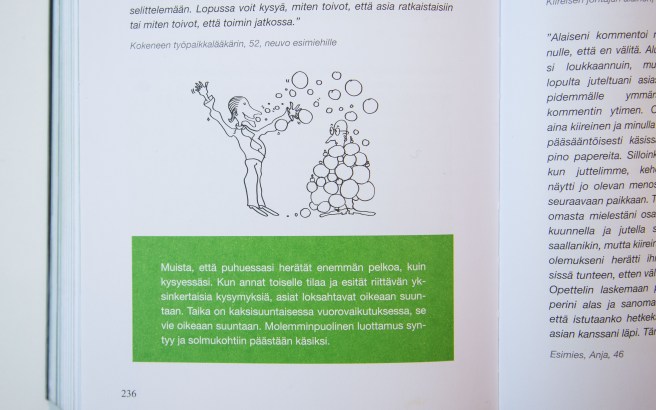
The part I liked the most was the two-page long “toolkit” part at the end of the book, which had some good points for dealing with upset people, whether they’re leaders or employees. But other than that, the book provided very little help for solving the issues we experience at workplaces. A not-so-well written book, but an important topic and for sure, the authors could have done much better in providing guidance and insights for coping in difficult situations. I gave two stars, as it might function as a reminder on how every leader should consider their leading style. And despite the many errors, the simple language is hopefully understandable even for the simple people working in leadership.
⭐️⭐️ / 5
 This one was on my reading list for a while. Tunne lukkosi gained a lot of awareness in Finland and as I’ve always been interested in psychology I had to read it. And now I finally did. I was actually surprised that I could find it at a library in Sweden. Without getting to know the topic before hand, it first seemed familiar, until after a brief googling I found out that tunnelukko was just a Finnish term for life traps. And about a year ago I had read
  Before, or at the beginning of the book, you’re recommended to take a test in order to find out which life traps are present in your life. The test is included in the book, but I found an easier
  I’d recommend this book for pretty much anyone who’s willing to look back into their childhood and grow as a person today. We all have life traps, some more subtle, some more visible, but it’s always useful to look inward and see how we can function in a more constructive and more responsible way.
 Nothing mind-blowing really, but the book definitely gave a good perspective on most common contexts where a good copy is needed. The book was especially good in describing what kind of tone to use and why. For most parts still valid information today, but as the world of communication is moving forward and developing at an extremely fast pace, it has the potential to expire. Though that’s also an opportunity for a new edition. More or less the same information and advice (and more) could also be Googled just as easily, but if you want all the essentials in one package, this might be the perfect one.
 I must admit. Read a lot of self-help. And most self-help is useless, as for most of us it’s just common sense. So was this book about being kind and what are the benefits of it. But I’m sure for some, Stefan Einhorn’s The Art of Being Kind is a good reminder of how, quite often, what you give is what you get.
 But I must say, I agree with almost everything said in the book and in a sense it was a nice way to collect together the aspects of kindness. And I’m not saying that it was a waste of time, I just think reading it once was enough for me. And at least, I learned new words in Swedish as it wasn’t available in English here. I try to be kind to others as well as I can, and think the world would be a better place if everyone was which pretty much sums up the point of the book.
 Pink Horrors